
We've spent the last 3–4 years obsessing over developer velocity, shaving seconds off CI/CD pipelines and hours off feature delivery. But hyper-speed carries a quiet, unbudgeted transaction fee. To see where it gets deducted, you have to look at two Thursday evenings, eight years apart.
Alice's Autonomy
It's a pretty Thursday evening in 2018: Alice just shipped a moderately difficult business feature after two sprints of hard work.
She had been balancing the load between herself and her team, creating issues, rigorously reviewing PRs and whatnot. Alice felt on top of the world and had a short-lived god complex.
Alice comes home and tells her family about her work; although they don't understand a word she says, they feel happy for her. She feels happy about herself and her work. She gets a good night's sleep.

Bob's Automation
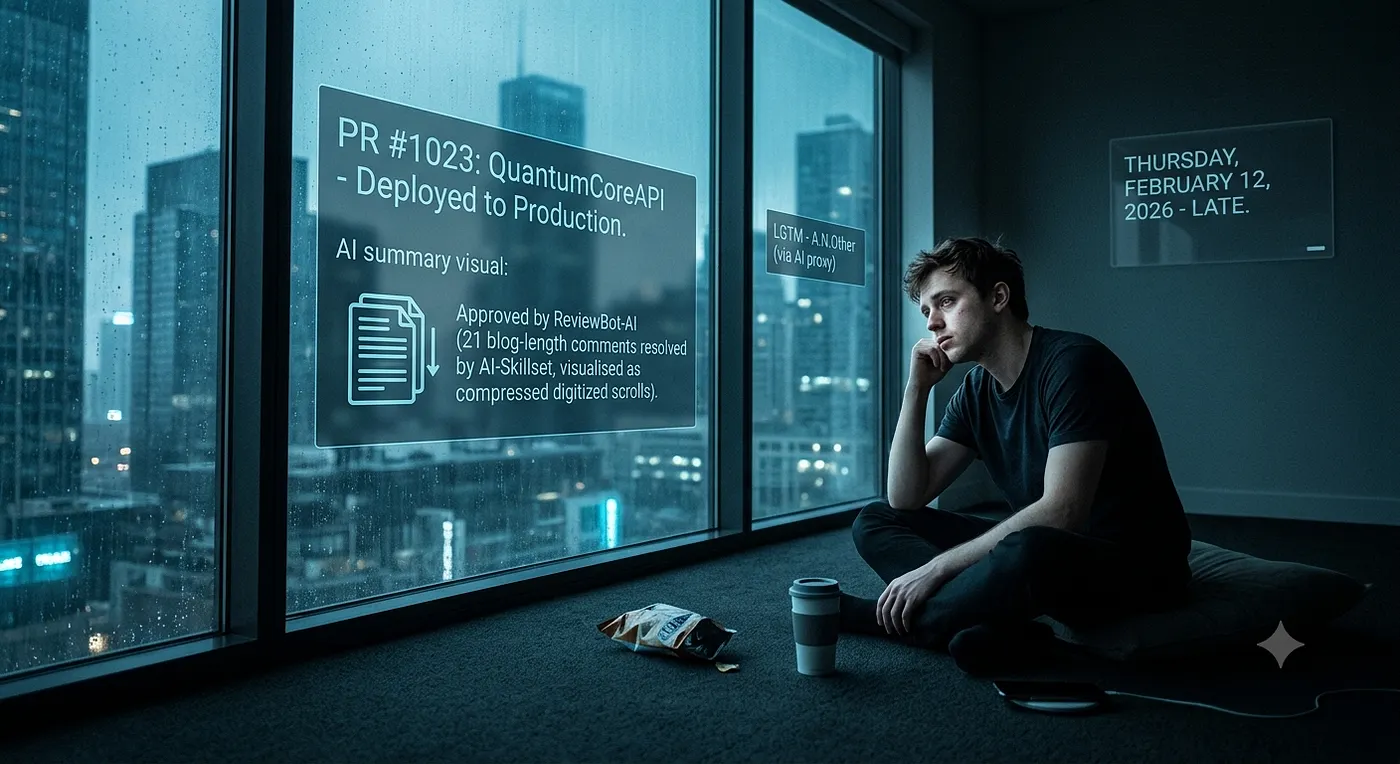
Rolling the camera forward: It's another pretty Thursday evening in 2026. Bob's pull request to ship the product's most critical feature is finally approved by an AI code review bot, after the bot leaves 20 article-length comments.
Bob used AI to write the feature entirely on his own. He used an AI workflow to resolve comments and auto-generate replies, boosting his delivery speed tenfold. His teammates, busy vibe-coding their own features, didn't bother reviewing his code; one simply stamped an "LGTM" after the bot greenlit the PR.
Bob has just delivered the most important feature of the product, yet he doesn't feel on top of the world. It feels like just another transactional day. He goes home, but he doesn't talk about his work.
Bob sits alone and stares into the abyss. He does not feel the excitement of shipping a valuable feature or a sense of accomplishment or novelty in his work. He questions his worth and existence as an engineer and has trouble falling asleep.
The Expense Is Multi-Dimensional
While mainstream LLM API costs range from $0.03 to $10.00 per million input tokens, with output tokens generally costing 3 to 6 times more, the actual expense here is far heavier and vastly more difficult to accept.
We measure cloud bills in dollars and cents, but we pay for our hyper-automated workflows in the slow currency of biological motivation.
What Bob experienced on that Thursday evening wasn't simple burnout; it was the quiet atrophy of his brain's evolutionary reward architecture.
For hundreds of thousands of years, the human dopamine system was designed to operate on a simple principle: effort precedes gratification. The neural high Alice felt in 2018 wasn't just about shipping code; it was the biological payload of two sprints of friction, uncertainty, and prolonged problem-solving.
When you endure the discomfort of deep thinking, your brain rewards the resolution with genuine mastery and self-worth. Generative AI destroys that friction. It completely decouples the effort from the output.
When an engineer can vibe code a major feature in hours using natural language prompts, the prefrontal cortex is effectively bypassed. The brain achieves an endpoint: a merged PR, a shipped feature, and a green checkmark with near-zero cognitive labour. But without the prerequisite struggle, the brain doesn't register the victory. It registers a non-event. The dopamine high flattens into a grey baseline, leaving you staring into the abyss despite a tenfold increase in speed.
Worse still, AI environments replace meaningful, earned achievement with a relentless stream of micro-stimuli:
- The Slot Machine of Code Generation: Every prompt yields an unpredictable response, triggering micro-doses of anticipatory dopamine that trap us in endless iteration loops without ever yielding deep satisfaction.
- The Erosion of Social Cohesion: By replacing human collaboration and peer reviews with automated bots and isolated solo-coding, we eliminate the authentic social validation that grounds our identity at work.
- Instant Gratification Atrophy: As impulse-control mechanisms degrade under constant digital hyper-stimulation, our capacity for "productive frustration": the very state where innovation and mastery live, dwindles to near zero.
When we calculate the ROI of artificial intelligence, we tally latency, token counts, and developer velocity. But the hidden line item on the invoice is human agency. The real cost of high AI usage isn't the API bill at the end of the month; it's the quiet erosion of the human drive to create, endure, and feel truly proud of the work we leave behind.
So, where do we go from here?
We don't need to throw away our tools or pretend AI hasn't fundamentally altered how we work. But if we want to remain whole as engineers, creators, and humans, we must treat our cognitive friction as a non-renewable resource worth protecting.
Efficiency is a metric for machine operations, not human fulfilment. If you want to feel that 2018 feeling again, the quiet, late-night pride of having conquered something difficult, you have to intentionally choose hard things. Step away from the prompt box. Solve a complex architectural boundary on paper. Debate a design in person with a teammate instead of deferring to a bot.
AI can write our boilerplate, but it shouldn't be allowed to write off our agency. The ultimate ROI of tech was never just output; it was who we became while building it.