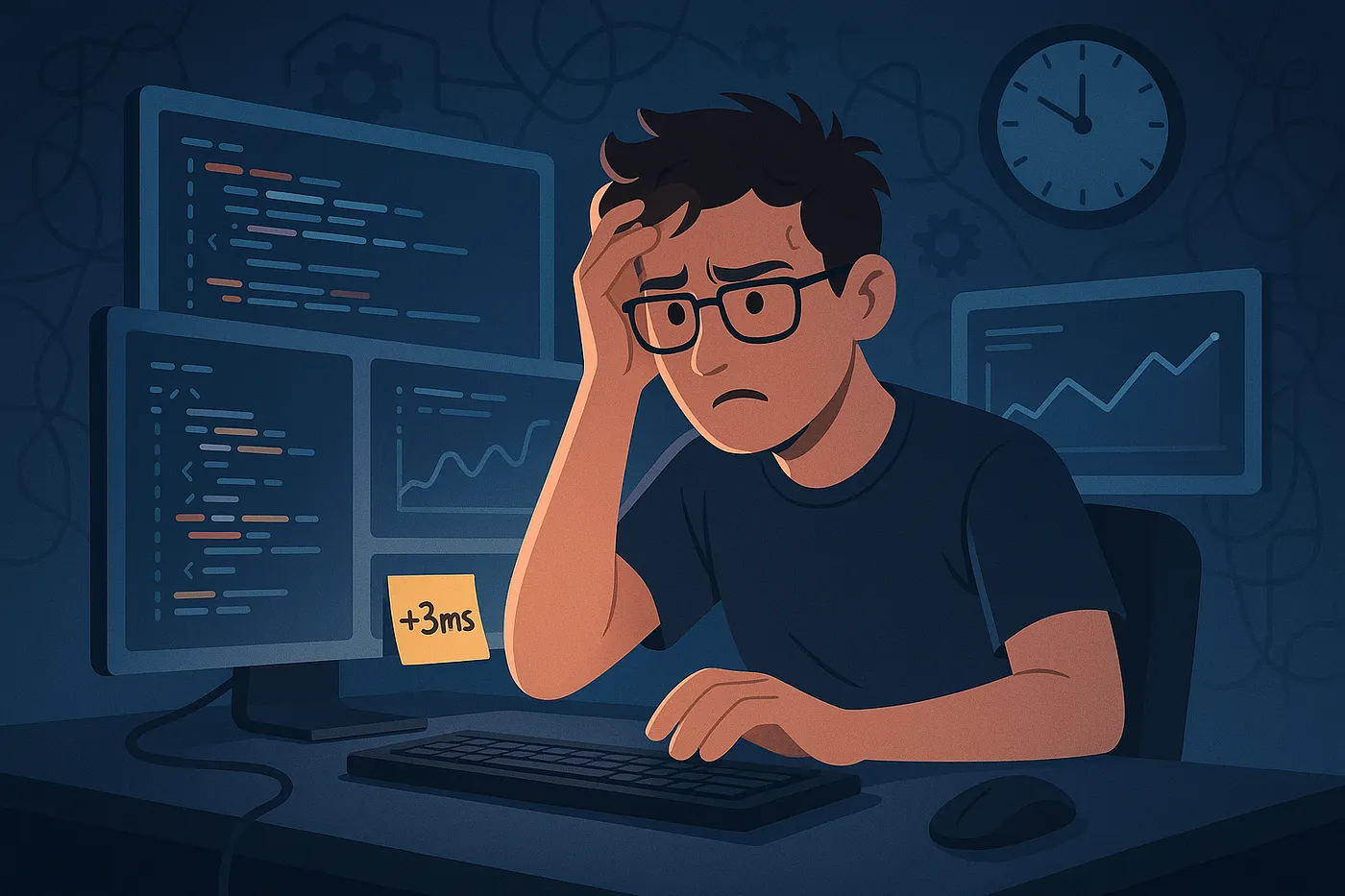
"Weeks of work, hours of tuning, and I shaved off 3 milliseconds. No one noticed."
A few months ago, I was working on a small internal dashboard for my side project with a few team members — a simple CRUD app that displayed analytics from a database. Everything worked smoothly, but I decided to "optimize" a function that fetched and displayed recent reports.
What started as a quick refactor turned into a rabbit hole: I split logic across multiple files, introduced memoization, tried out caching layers, and even played with raw SQL for a subquery that wasn't even causing any lag.
By the time I finished, I had reduced the API response time from 142ms to 139ms — a 2% gain on an endpoint that was already fast and infrequently used.
But the tradeoff?

Unfortunately, I took the red pill, and now:
- The code was no longer readable.
- A team mate introduced a bug trying to modify the same logic later.
- Worst of all, I spent two evenings doing something no one had asked for.
That's when it hit me: I had optimized too early — and for the wrong reasons.
What Is Premature Optimization, Really?
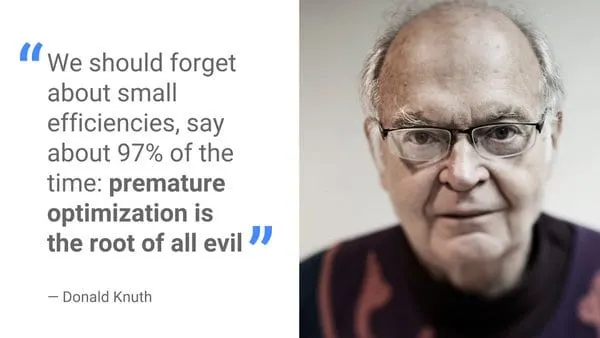
The phrase "premature optimization is the root of all evil" is one of the most quoted lines in programming, but often misunderstood.
It doesn't mean you should never optimize. It means optimizing too early — before understanding the real performance needs — can be more harmful than helpful.
In other words, optimizing without data is like treating an illness you don't have.
Why We Fall for It
If you've ever tried to optimize something too early, you're not alone. It's an easy trap — and it usually doesn't come from laziness. In fact, it often comes from trying too hard to be clever.
Here are some of the common reasons developers fall into premature optimization:
Ego Disguised as Efficiency
We love writing "smart" code — the kind that uses clever patterns, efficient algorithms, or low-level tricks. It feels good to write something that looks performant, even if the difference is negligible.
But often, what looks smart in a vacuum ends up being:
- Harder to understand
- Impossible to maintain
- Solving a problem that doesn't (yet) exist
Fear of Future Scale
It's tempting to design for a theoretical future where your app has millions of users and needs blazing-fast response times. So you add caching, debounce handlers, and database indexing strategies — all on day one.
But the truth is, most code never gets that kind of scale. And the time you spend now might be better spent building features, writing tests, or gathering user feedback.
Build for now, optimize for scale when it's real.
Tutorial and Conference Syndrome
You've seen talks where someone reduced execution time from 10 seconds to 10 milliseconds with some exotic trick. Or you followed a tutorial where optimization was baked into the solution from the start.

It's inspiring — but also misleading. These examples often:
- Isolate a very specific bottleneck
- Skip over context (like how often that function is actually called)
- Exist purely to demonstrate optimization
You don't get to see the 95% of the app that just uses plain, boring, readable code — because that part isn't flashy.
Misplaced Priorities
We often optimize what's easy to tweak, not what's actually slow.
It's like rearranging furniture in a room because the door squeaks — it feels productive, but doesn't fix the core issue.
When Optimization Hurts
Premature optimization isn't just a harmless detour. It can actively make your code — and your team — worse off.
You Sacrifice Readability for Speed You Don't Need
Code that's heavily optimized often becomes less readable:
- It uses cryptic logic.
- It breaks abstraction boundaries.
- It introduces clever tricks that need comments just to be understood.
You might save a few milliseconds, but now every future developer (including future-you) has to work harder to understand what's going on.
Here's an example:
Easy-peasy & Readable (but not THAT optimized)
function getCompletedTaskTitles(tasks: Task[]): string[] {
  return tasks
    .filter((task) => task.status === "done")
    .map((task) => task.title);
}
You don't need to be a senior developer to understand this:
- Take all done tasks
- Return their titles
It's declarative, expressive, and easy to debug or change.
Prematurely Optimized (Cryptic, Over-engineered)
function g(t) {
  const r = [],
    l = t.length;
  let i = 0;
  for (; i < l; ++i) t[i].status === "done" && r.push(t[i].title);
  return r;
}
Technically, it minimizes variable names, avoids .filter() and .map() overhead, and saves a few milliseconds… maybe. But now:
- It's impossible to skim and understand
- Variable names are meaningless
- The logic is compact but unreadable
You didn't make the code faster — you just made it harder to live with.
Unless you're working in a performance-critical loop (like graphics rendering or a tight game loop), this kind of optimization does more harm than good. Readable code is often "slower" in theory — but much faster for humans to work with.
Optimization should never come at the cost of clarity — unless the performance gain is measurable and necessary.
You Create Technical Debt
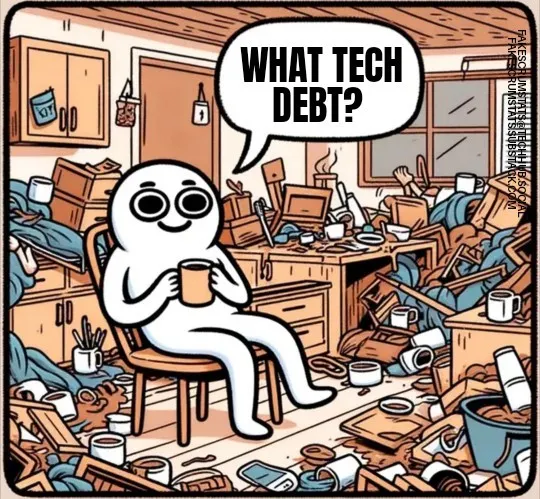
That extra layer of caching you added? The index you prebuilt? The five new utility functions for "performance"? Now they're part of the system — and they all need to be maintained, debugged, and understood.
If the optimization wasn't solving a real problem, it just became technical debt in disguise.
You Lock Yourself Into the Wrong Abstractions

Optimizing too early can box you into decisions that are hard to reverse:
- Choosing a data structure for speed before your data needs are clear.
- Hard-coding performance hacks that make future flexibility difficult.
- Splitting logic too early across multiple modules to "reduce call stack depth."
Sometimes, it's better to be a little inefficient now — and flexible later.
You Waste Time That Could Be Spent Better
Time is your most limited resource as a developer. Every hour you spend shaving milliseconds off an already-fast operation is an hour not spent:
- Building new features
- Writing tests
- Fixing real bugs
- Talking to users
Optimization isn't free — so treat it like any other investment: justify it, measure it, and prioritize wisely.
When Should You Optimize?
Optimization isn't the enemy — it just needs to happen at the right time. Here's when it's actually worth it:
You've Measured a Problem Use profilers, logs, or real metrics. If something is actually slow, you'll see it. Don't guess — measure.
Users Are Noticing If users complain about slowness, lag, or poor UX — that's your cue. Optimize what impacts the experience.
The Code Runs Frequently A slow operation in a loop or high-traffic path is a good target. One-time scripts? Probably not.
You're Targeting Low-End Devices In performance-sensitive environments like mobile or embedded systems, early tuning is often necessary.
The Code Is Stable Once your feature works, is tested, and won't change soon — that's a safe time to optimize.
Bottom line: Optimize only when it solves a real, measured problem — not an imagined one.
Conclusion
Premature optimization isn't just a technical misstep — it's a distraction. It pulls you away from what matters most: building clear, maintainable, and working software.
Yes, performance matters. But only when it's rooted in real problems, backed by measured data, and driven by user impact.
Readable code is a long-term investment. Prematurely optimized code? That's often just short-term ego.
Next time you're tempted to "tweak it now to make it faster" — ask yourself: faster for whom, and why now?
If you don't have a clear answer, keep it clean, keep it simple — and optimize later.